


"Where do we rank in ChatGPT?" is a question that assumes something the system does not produce: a ranked list, sampled once, returned the same way twice. Rank tracking as it exists for classic SERPs resists every one of those assumptions when the surface is a generative answer.
Four structural properties of AI search make single-point measurement unreliable. The SERP is synthesized per query, model output is non-deterministic at temperature zero, grounding is personalized per session, and citations do not encode position. Distributional sampling is the only honest way to approximate visibility inside AI Overviews, ChatGPT, Gemini, and Perplexity.
No Stable SERP Sits Behind the Answer
Classic rank tracking fetches a page of ten ranked links, parses positions, and caches them for a dashboard. The artifact that most commercial queries now return is a synthesized answer assembled from a retrieval step, not a persistent document in an index. Research on AI Overview stability found only 11% of results cited the same sites as the day before, and content persistence averaged 2.15 days across 43,000-plus keywords — citation is volatile by design.
Coverage has expanded alongside that volatility. AI Overviews now sit above the large majority of tracked commercial keywords, while Perplexity, ChatGPT and Gemini return answers with no adjacent ranked list at all. For context on what the old tooling category still does where a classic SERP exists, see our rank tracker comparisons.
A single daily scrape against an AI answer surface is sampling from a volatile, synthesized result set. It is not reading a position.
Temperature Zero Is Not Reproducible
The second failure mode lives inside the model. Running identical prompts at temperature zero, which should in theory produce a single deterministic completion, does not. Thinking Machines Lab sent the same prompt 1,000 times and received 80 distinct completions, because kernels like RMSNorm, matmul and attention are not batch-invariant at the numeric level; identical inputs produce different outputs depending on what else is in the batch.
The operational consequence is specific. A rank tracker querying ChatGPT or Perplexity once per day for a given keyword draws one sample from an output distribution with measurable width, then reports it as if it were the engine's state. Movement across weeks is partly the model's intrinsic noise, not a change in the underlying citation ranking. Reports of "ChatGPT rank" built on single daily queries conflate sampling variance with visibility change.
Grounding Is Personalized Per Session
The third failure mode is grounding. The retrieval set each engine hands its model is conditioned on account signals, geography, device, prior messages in the session, and server-side experiments. Two users running the same query receive different context, different citations, and often different answers. A dashboard scraping from one data-center IP measures that IP's slice, not the audience.
The surface area of the personalization problem keeps expanding. Google AI Mode launched in August 2025 and grew along multiple axes at once: geography, language coverage, and query volume. Those rollouts overlapped rather than succeeded one another, which is why a snapshot taken against one locale in one week does not generalize to another.
The infrastructure that once produced representative SERP samples for classic search becomes necessary again, calibrated for session fingerprinting rather than IP rotation alone. Cost design starts to resemble the trade-offs in routing across models, because each sample now runs through a generative engine rather than a static index.
A Citation Is Not a Position
Rank meant one of ten. Citation means presence or absence in a synthesized answer, with inline order a weak secondary signal. A Qwairy Q3 2025 analysis of more than 118,000 AI-generated answers found Perplexity averaged 21.87 citations per response, ChatGPT averaged 7.92, and only 11% of domains were cited by both engines for the same query. The engines are ranking different universes.
Position within one answer does not map onto position within another, and neither maps onto click weight. SparkToro's 2026 study reports 68% of Google searches end without a click, 77.2% on mobile, so the historical bridge from rank-one to traffic is weaker even where the SERP still exists.
Citation also decays unevenly across engines, which is the Ahrefs finding above made concrete. A metric that reports a single rank per keyword hides which engine cites the domain, how often, at what inline position, and for how long before the citation set reshuffles.
Distributional Sampling as the Only Honest Approximation
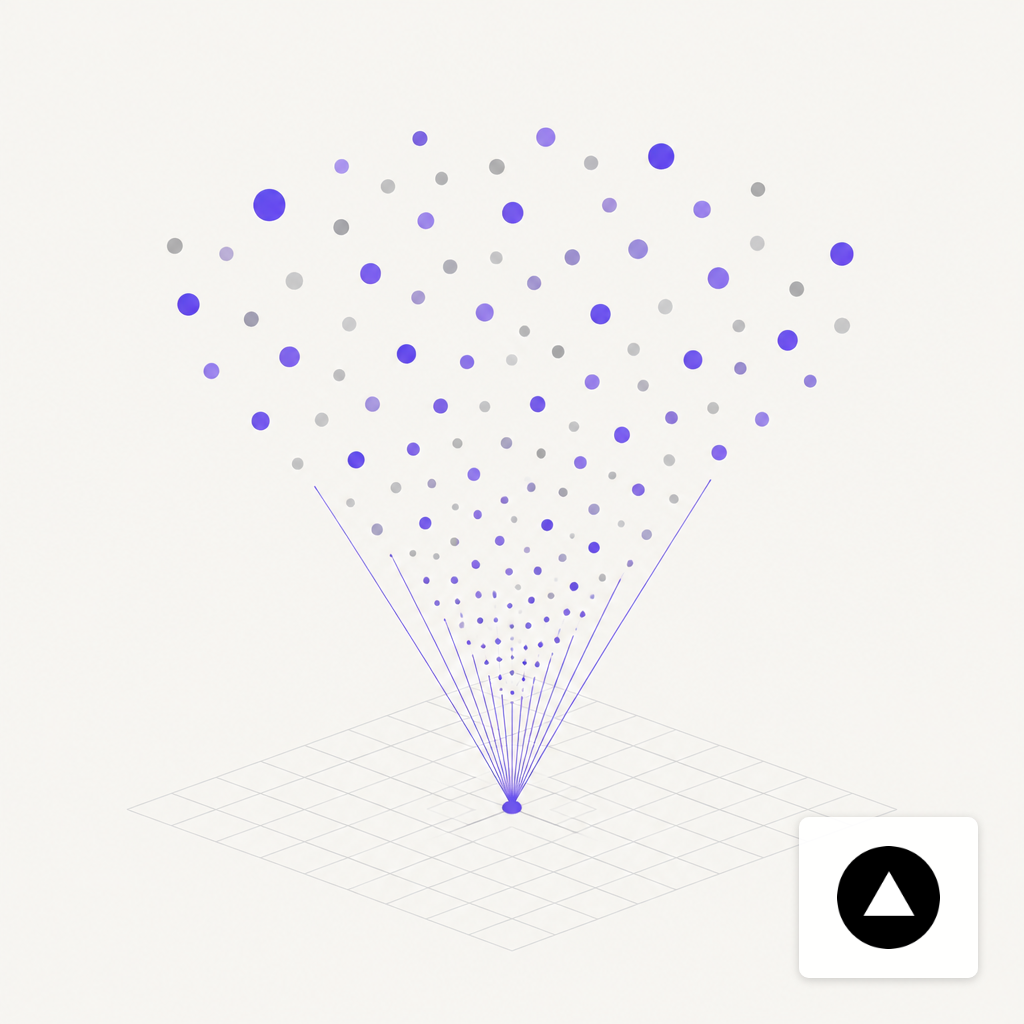
The protocol-level fix is to treat each engine as a sampling problem. For every tracked query, issue N completions across varied session fingerprints: geography, account cohort, device, time of day. Store each raw response. Extract the citation set per response. Compute the empirical citation rate per domain per query per engine, with confidence bounds. The output is a distribution, not a position.
The pipeline reads like this. A query planner enumerates keywords and the fingerprint grid. An execution layer routes each call through the target engine's API where one exists, or through session emulation where it does not. A proxy layer supplies the IP and locale variation. An extraction layer parses citations from each completion. A storage layer retains full outputs, not derived positions, so new metrics can be computed retroactively without re-querying.
Cost scales with sample width. One thousand queries at fifty samples per query across five engines produces 250,000 completions per refresh, which is why routing by model cost and quality matters as much as the sampling design itself. The extraction, rotation and storage components are the same ones used for classic web extraction features, calibrated for a different measurement unit — a completion and its citation set, rather than a page and its position.
The Trade-Off Worth Making
What the reader gives up by switching to distributional sampling is the single-cell dashboard. There is no "rank 3 in ChatGPT" to drop next to a keyword, because the engine did not produce one. The deliverable is a presence rate with a confidence interval, segmented by engine and session cohort. Executives who asked for a ranking get a different artifact, and interpretation takes an extra step.
That trade-off is usually worth making, because the single number was already fiction. A presence rate of 62% in AI Overviews across US desktop sessions, with 11% on Copilot and 48% on Perplexity, describes the actual visibility surface. A scraped "rank 2" against a volatile, synthesized, per-session answer does not, and reporting it to an executive as if it did is a measurement debt that compounds.

Written by
Eric LamannaEric Lamanna is VP of Business Development at Search.co, where he drives growth through enterprise partnerships, AI-driven solutions, and data-focused strategies. With a background in digital product management and leadership across technology and business development, Eric brings deep expertise in AI, automation, and cybersecurity. He excels at aligning technical innovation with market opportunities, building strategic partnerships, and scaling digital solutions to accelerate organizational growth.