


Every enterprise search team eventually asks the same question: should the model live inside the perimeter, or stay on someone else's GPU? The usual answer is reflex rather than analysis. Security leads lean private, finance leads lean API, and the retrieval pipeline gets built around whichever side wins the meeting.
The honest answer depends on token volume, latency targets, data classification, and how often the model is actually the bottleneck. Open-weight checkpoints like Llama 3.1 70B, Qwen, Mistral, and gpt-oss are now good enough that the quality gap against hosted frontier models is narrow for retrieval-grounded workloads. The infrastructure gap is not. This piece walks through where a private LLM earns its rack space inside an enterprise search stack, and where BYOK routing to Claude, GPT-5, or Gemini is still the right default.
What "Private LLM" Actually Means in a Search Stack
A private LLM is any model you control end-to-end inside your boundary. The industry taxonomy from LLM.co and others treats it as three deployment shapes: on-prem on hardware you own, a dedicated VPC on AWS, Azure, or GCP, and an air-gapped build with zero egress. All three serve the same open-weight model behind the same control plane; what changes is who holds the keys to the rack.
In a search stack, the model is one of several hot components. The ingestion layer scrapes and normalizes. The embedding model vectorizes. The retriever pulls candidates. The generator writes the answer. Only the last step strictly needs a general-purpose LLM, and in RAG the generator is doing comprehension over retrieved context more than open-ended reasoning. That matters, because a 70B-class open model is often sufficient when retrieval is strong, and overkill when retrieval is weak.
LLM.co's on-prem deployment guidance frames the typical build as containerized inference on Docker or Kubernetes, served from H100, H200, L40S, or RTX 6000 hardware, with the same control plane across cloud, on-prem, and edge. For a search team, the practical read is that the model is not the hard part. The retrieval pipeline, the audit logs, and the access controls are.
The Case For Running the Model Yourself
Three forces push teams toward private deployment, and all three are real.
Data exposure risk is not hypothetical. A data protection firm counted 6,352 attempts to paste corporate data into ChatGPT for every 100,000 workers on its customers' payrolls. A separate Menlo Security analysis found 57% of employees submitted sensitive data to free-tier AI tools, with 155,005 copy and 313,120 paste attempts logged in a single month across enterprise environments. Cyberhaven telemetry across 7 million knowledge workers found 34.8% of data submitted to AI tools was sensitive and 83.8% of traffic flowed to external tools rated medium, high, or critical risk. For regulated workloads, keeping prompts and context inside the boundary removes an entire class of incident from the register.
Compliance posture gets simpler, not harder. SOC 2, HIPAA, GLBA, and CMMC audits all turn on who sees what data and when. A private deployment collapses the vendor diligence surface to one hardware boundary and one access-control plane. The IBM 2025 breach research surfaced across governance reporting found that 97% of organizations that reported AI-related breaches lacked proper AI access controls. Private LLMs do not fix that on their own, but they put the controls inside systems the compliance team already understands.
Economics flip above a certain token volume. Private deployment typically becomes economically justified against managed APIs at roughly 2 million tokens per day, or around 8,000 conversations daily, with the same source noting that 68% of enterprise teams underestimate first-year LLM spend by more than 3x. A separate 2026 cost analysis puts the break-even against GPT-5.4 and Claude Sonnet 4.6 higher, at 100 to 256 million tokens per month, a threshold most production systems never actually reach.
The Case Against, Measured in GPUs and Latency
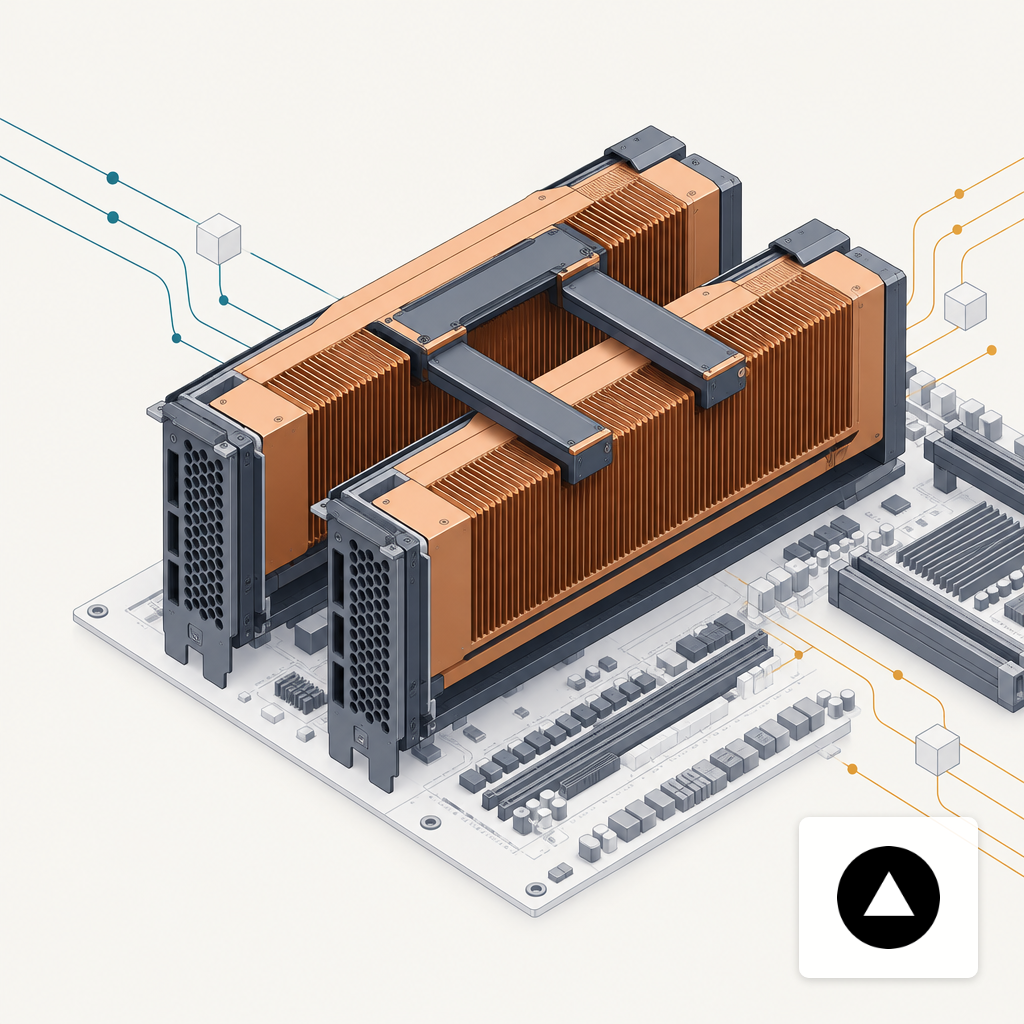
The counterweights are physical. Llama 3.1 70B at FP16 is 140 GB of weights, which does not fit on a single 80 GB H100. Running the model in full precision on one card requires an H200 at 141 GB, or splitting across two H100s with tensor parallelism. INT8 quantization halves the footprint to 70 GB and fits a single H100 with headroom for a short KV cache. Context length is the hidden multiplier: a 70B at Q3 with 128K context pushes toward 84 GB on its own.
Inference runtime choice is the other half of the bill. Benchmark data from a 2026 self-hosted LLM comparison shows vLLM holding sub-100ms P99 latency at 128 simultaneous users while Ollama's latency spikes to 673ms under the same load. Developer-focused runtimes are not production-grade runtimes, and swapping between them is not a configuration flag.
Then there is the quality question. Llama 3.1 70B Instruct posts 83.6 on 5-shot MMLU and 66.4 on MMLU-Pro, which is in reach of leading closed-source performance but not above it on open-ended reasoning. For retrieval-grounded answers the gap often disappears; for synthesis across long, messy context it does not.
Where Each Approach Wins Inside a Search Stack
Mapping deployment choice to the search pipeline is more useful than treating it as a global decision. Different stages have different sensitivity profiles and different token economics.
- Scraping and extraction. No private LLM required. The proxy layer and parsers do the work; a small open model handles cleanup. Token volume is high, quality bar is low, latency per call does not matter.
- Embedding generation. Private open-weight embedding models (bge, e5, nomic) are standard practice. Hosted embedding APIs leak the entire corpus by design.
- Retrieval and reranking. Private cross-encoder rerankers are small, cheap, and faster locally than over the network.
- Grounded answer generation on sensitive data. Strong case for private 70B-class generation. The context contains the sensitive material, not just the query.
- Open-ended synthesis, competitor analysis, multi-step agents. BYOK routing to frontier models usually wins on quality per dollar, especially for intermittent heavy jobs.
- Citation checking and formatting. Small private models are fine. These are mechanical passes.
The pattern most mature teams converge on is a hybrid: embeddings and reranking private, generation routed by data classification. Public corpora route to the cheapest capable frontier API; regulated data routes to the on-prem 70B. The same approach shows up in the cost math behind multi-provider routing, and in the internal search patterns for private corporate databases.
Fine-Tuning: When Custom Weights Earn Their Keep
Fine-tuning gets pitched as the reason to go private. In practice it is a smaller win than most teams expect, because RAG covers most of what prompt-shaping and in-context examples would have done. LoRA on a 70B needs roughly 160 GB of GPU memory, Q-LoRA brings that down to around 48 GB, and full fine-tuning crosses 500 GB. The compute is not the problem; the training data pipeline is.
Custom weights earn their keep in three narrow situations. First, domain vocabulary that general models get wrong consistently, such as internal product codes, legal boilerplate, or clinical shorthand. Second, structured output formats where the schema is stable and the model needs to stop hallucinating fields. Third, latency-sensitive classification where a fine-tuned small model replaces a prompted large one. Everything else is better served by better retrieval.
A Decision Framework That Holds Up
The honest decision rule is boring. Classify the workload by three axes and the answer usually writes itself.
Daily token volume determines whether the GPU bill amortizes. Data classification determines whether the prompt can leave the perimeter at all. Latency budget determines whether a two-H100 node is required or a cold API call is tolerable. Teams that get this wrong usually get it wrong in one direction: they build a private stack for a workload that would have cost less on an API, or they route regulated prompts to a hosted model because the private deployment slipped a quarter.
There is a fourth axis worth naming: operational maturity. Running vLLM in production, managing GPU driver upgrades, handling model version rollouts, and keeping a 24/7 inference SLA is a real engineering function. If the team does not have it, the private LLM will underperform the hosted API on both cost and reliability for the first year.
What to Build First
Most search teams should not start with a private LLM. They should start by instrumenting token spend by workload, classifying prompts by data sensitivity, and routing accordingly. Once a workload crosses the volume threshold or hits a hard compliance line, the private deployment follows the demand instead of leading it. The same discipline applies when deciding whether to build or buy a multi-agent runner: scope the volume first, pick the hardware second.
For teams that have already crossed those thresholds, the stack converges on a predictable shape. Private embeddings, private reranking, private 70B generation for sensitive data, BYOK routing for everything else, with the same control plane across all of them. That is the configuration LLM.co's on-prem documentation describes, and it is close to what most production RAG deployments look like once the hype settles. The features and pipeline primitives that matter are the same either way: versioned retrieval, grounded generation, audit logs, and a routing layer that treats the model as a replaceable component rather than a brand loyalty.
A private LLM is a tool, not a strategy. It earns its rack space when the token volume, the data classification, or the latency budget demand it, and only then. For every workload that does not clear the bar, BYOK routing to a frontier model remains the cheaper, faster, and often higher-quality default.

Written by
Timothy CarterTimothy Carter is the Chief Revenue Officer at SEARCH.co , where he leads global sales, client strategy, and revenue growth initiatives across a portfolio of digital marketing and software development companies. With over 20 years of experience in enterprise SEO, content marketing, and demand generation, Timothy helps clients—from startups to Fortune 1000 brands—scale their digital presence and revenue. Prior to his current role, Timothy led strategic growth and partnerships at several high-growth agencies and tech firms. Tim resides with his family in Orlando, Florida.